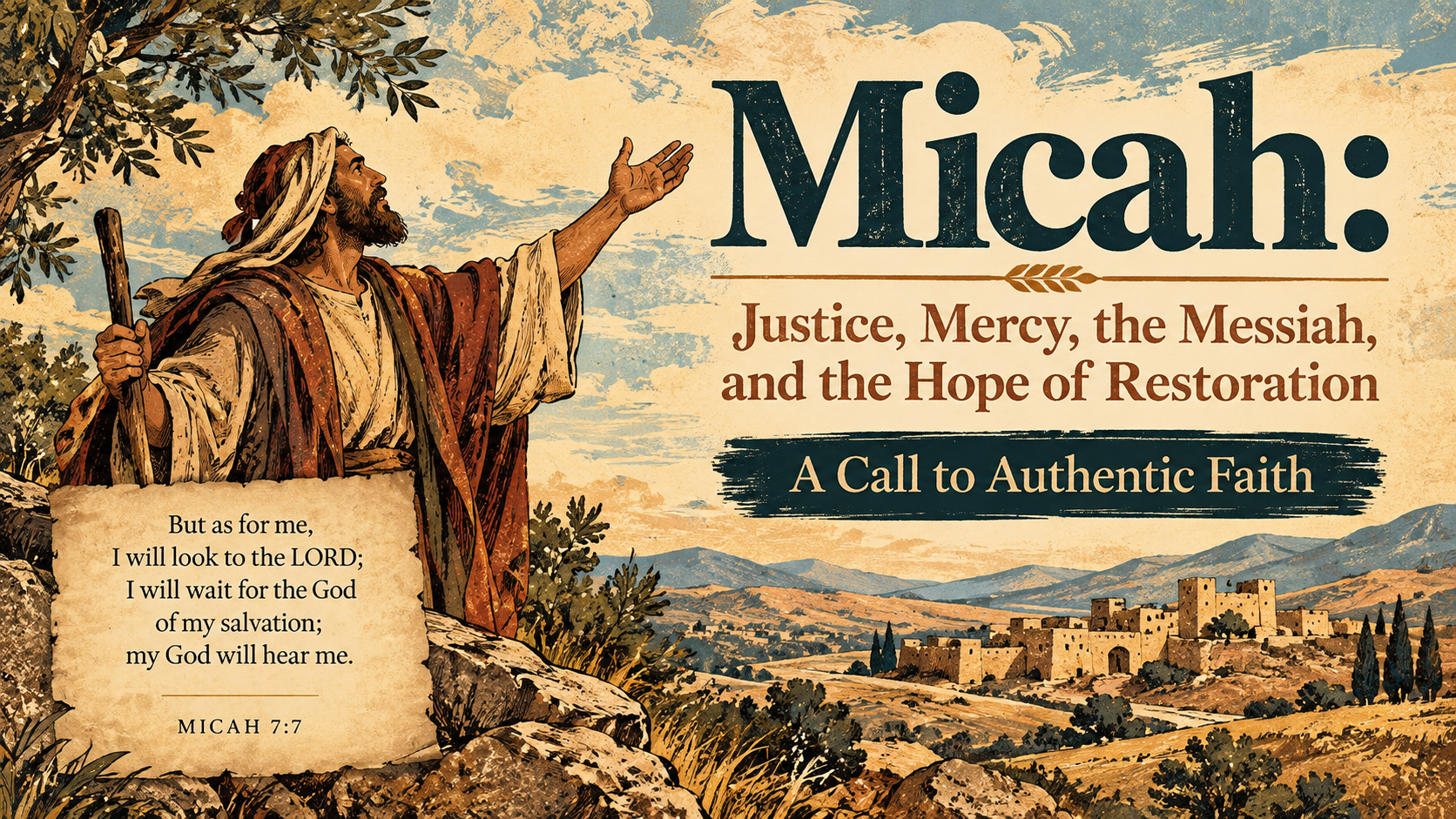
Micah: Justice, Mercy, the Messiah, and the Hope of Restoration
A 15-lesson study of Micah exploring covenant justice, corrupt leadership, true worship, the future kingdom of peace, the ruler from Bethlehem, humility, mercy, forgiveness, and restoration.
Course Description
Micah: Justice, Mercy, the Messiah, and the Hope of Restoration is a 15-lesson study of Micah 1-7. Students examine judgment against Samaria and Jerusalem, exploitation and corrupt leadership, false prophecy, the future kingdom of peace, the ruler from Bethlehem, God's covenant case, the call to do justice, love mercy, and walk humbly, and the book's closing celebration of divine forgiveness and covenant faithfulness.
What You Will Learn
Learning Objectives
- Understand Micah's historical setting and message to Samaria and Jerusalem.
- Explain Micah's condemnation of exploitation, corrupt leadership, dishonest wealth, and false prophecy.
- Trace the book's recurring movement from judgment toward hope and restoration.
- Interpret Micah 4's vision of God's future kingdom, instruction, justice, and peace.
- Explain the significance of the ruler from Bethlehem in Micah 5 and the New Testament connection in Matthew 2.
- Understand the covenant context of Micah 6.
- Explain Micah 6:8 within the message of the whole book.
- Describe faithful waiting for God amid social corruption in Micah 7.
- Explain Micah's closing portrait of God's forgiveness, compassion, steadfast love, and covenant faithfulness.
- Apply Micah responsibly to worship, leadership, justice, mercy, humility, repentance, and Christian hope.
Course Overview
Course Content
Fifteen substantial self-study lessons cover Micah 1-7: judgment on Samaria and Jerusalem, lament, exploitation, false prophets, corrupt leaders, the mountain of the Lord, peace among the nations, restoration after exile, the ruler from Bethlehem, the remnant, God's covenant case, Micah 6:8, dishonest wealth, faithfulness amid corruption, hope after discipline, and God's incomparable mercy. Each lesson contains substantial HTML teaching, a plain-text assignment, and four multiple-choice questions.