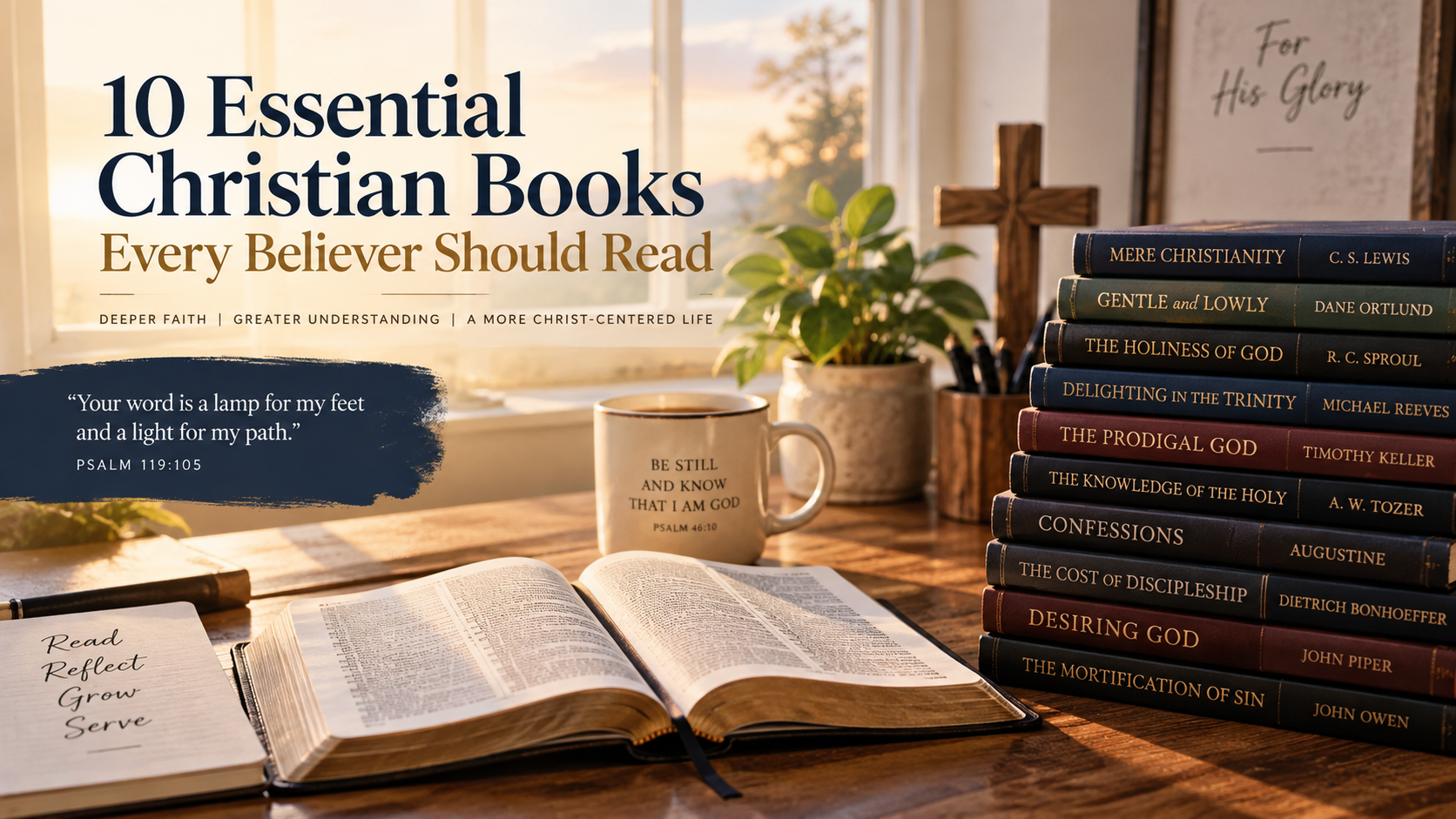
10 Essential Christian Books Every Believer Should Read
Christians have always been people of the Book. Scripture stands at the center of Christian faith, teaching, worship, and discipleship. No Christian book can take the place of the Bible. Yet throughout Christian history, thoughtful writers, pastors, theologians, and teachers have produced works that can help readers examine important biblical themes, ask deeper questions, and grow in their understanding of Christian faith and life.
The books in this list approach Christianity from different periods, traditions, and perspectives. Some focus on apologetics, others on the character of God, grace, discipleship, the Trinity, holiness, or the struggle against sin. Together, they provide a valuable reading path for Christians who want to continue learning beyond a structured Bible course.
These recommendations should therefore be read alongside Scripture rather than instead of Scripture. Readers are encouraged to examine every theological claim carefully in light of the biblical text.
1. Mere Christianity by C.S. Lewis
Mere Christianity is one of C.S. Lewis's best-known works of Christian apologetics. The book grew out of radio talks Lewis delivered during the Second World War and seeks to explain and defend beliefs he regarded as central to Christianity.
One of the strengths of the book is Lewis's ability to take difficult philosophical and theological ideas and communicate them through memorable arguments, illustrations, and everyday language. He discusses moral law, human behavior, Christian belief, virtue, faith, and the Christian understanding of God.
Why read Mere Christianity?
It can be particularly useful for readers interested in Christian apologetics and the rational examination of Christian claims. It also introduces questions that can lead students into deeper study of theology, ethics, and the relationship between reason and faith.
Because Lewis writes from his own theological perspective, readers should still compare his arguments carefully with Scripture rather than treating the book as a substitute for biblical study.
2. Gentle and Lowly by Dane Ortlund
Gentle and Lowly: The Heart of Christ for Sinners and Sufferers focuses on the character and compassion of Jesus Christ, taking particular inspiration from Jesus' description of himself in Matthew 11:29 as gentle and lowly in heart.
Rather than concentrating only on what Christ has accomplished, Ortlund asks readers to consider the heart of Christ toward weak, struggling, and sinful people. The result is a pastoral exploration of compassion, grace, mercy, and assurance.
Why read Gentle and Lowly?
This book may be especially helpful for Christians who understand doctrines of grace intellectually but struggle to understand Christ's compassion personally. It encourages readers to return to Scripture and consider how the New Testament presents the character of Jesus.
3. The Holiness of God by R.C. Sproul
Holiness is one of the great themes running throughout Scripture. The Holiness of God by R.C. Sproul explores what Christians mean when they confess that God is holy and considers the consequences of encountering the majesty and purity of God.
A biblical understanding of holiness does more than expand theological knowledge. It challenges how believers understand worship, sin, repentance, grace, obedience, and their relationship with God.
Why read The Holiness of God?
Sproul's work can help readers move beyond a casual conception of God toward serious reflection on divine holiness and human sinfulness. It pairs naturally with biblical passages such as Isaiah 6, where the prophet's encounter with God's holiness produces both awe and an acute awareness of sin.
4. Delighting in the Trinity by Michael Reeves
The doctrine of the Trinity can sometimes appear abstract or intimidating. In Delighting in the Trinity, Michael Reeves presents the triune nature of God as central to understanding Christianity rather than as an obscure theological puzzle.
The book considers the Father, Son, and Holy Spirit in connection with creation, salvation, prayer, Christian life, and God's love. Reeves also draws on insights from Christian history to show how belief in the Trinity has shaped Christian thought and worship.
Why read Delighting in the Trinity?
It provides an accessible introduction for students beginning to study Trinitarian theology. It can also encourage more careful study of biblical passages concerning the Father, the Son, and the Holy Spirit.
5. The Prodigal God by Timothy Keller
Timothy Keller's The Prodigal God explores Jesus' parable traditionally known as the Parable of the Prodigal Son. Keller pays attention not only to the younger son who leaves home but also to the elder brother who remains.
This approach draws attention to two very different ways people can become spiritually lost: obvious rebellion and outward moral obedience that nevertheless becomes self-righteous or self-centered.
Why read The Prodigal God?
The book encourages readers to examine their understanding of sin, grace, repentance, and the love of God. It can be especially valuable when read alongside Luke 15 so that Keller's interpretation can be considered directly in relation to Jesus' parable.
6. The Knowledge of the Holy by A.W. Tozer
The Knowledge of the Holy focuses on the attributes of God. A.W. Tozer reflects on subjects such as God's wisdom, grace, mercy, justice, sovereignty, and presence.
The chapters are relatively concise and devotional in character, making the book suitable for slower reading accompanied by prayer and Scripture study.
Why read The Knowledge of the Holy?
Christian theology begins with God. What believers think about God influences worship, prayer, obedience, ministry, and everyday Christian living. Tozer encourages readers to recover a sense of God's majesty and to consider whether their understanding of God has become too small or casual.
7. Confessions by Augustine of Hippo
Augustine's Confessions is one of the most influential works in Christian literature. Written largely as an address to God, it combines autobiography, prayer, theological reflection, and philosophical inquiry.
Augustine reflects on his earlier life, his desires, intellectual searching, sin, conversion, memory, and the grace of God. Because it comes from the ancient church, the book also gives modern readers an opportunity to encounter Christian reflection from a world very different from their own.
Why read Augustine's Confessions?
It reminds readers that questions about human desire, identity, restlessness, temptation, conversion, and grace are not unique to modern Christianity. Christians have wrestled with these matters for centuries.
It is a particularly valuable book for students interested in Christian history and the development of Christian thought.
8. The Cost of Discipleship by Dietrich Bonhoeffer
The Cost of Discipleship is closely associated with Dietrich Bonhoeffer's reflections on what it means to follow Jesus. A substantial portion of the work engages the Sermon on the Mount and considers the demands of Christian discipleship.
Bonhoeffer is especially remembered for contrasting what he calls cheap grace with costly grace. His discussion challenges forms of Christianity that affirm grace verbally without taking seriously Christ's call to discipleship.
Why read The Cost of Discipleship?
The book raises difficult questions about obedience, sacrifice, grace, Christian community, and following Christ when discipleship is costly. Its historical context also makes it significant for understanding twentieth-century Christian thought.
Readers may benefit from studying Matthew 5–7 alongside the book and evaluating Bonhoeffer's interpretation directly against the biblical text.
9. Desiring God by John Piper
In Desiring God, John Piper develops an approach he calls Christian Hedonism. Central to the book is the relationship between God's glory and the believer's joy in God.
Piper applies this theme to several dimensions of Christian life, encouraging readers to think seriously about worship, desire, prayer, Scripture, service, suffering, and the pursuit of joy in God.
Why read Desiring God?
The book challenges the assumption that Christian obedience and genuine joy must be opposites. Whether a reader ultimately agrees with every aspect of Piper's framework or not, the book provides substantial material for considering the biblical relationship between desire, worship, satisfaction, and God's glory.
10. The Mortification of Sin by John Owen
John Owen's The Mortification of Sin is a seventeenth-century Christian work dealing with the believer's continuing struggle against sin. Its central biblical foundation is closely associated with Romans 8:13 and the call to put sinful deeds to death through the Spirit.
Owen treats sin not merely as a collection of outward actions but as something that must be confronted at the level of desire, habit, temptation, and the heart.
Why read The Mortification of Sin?
For readers willing to engage an older theological work, Owen provides a serious treatment of sanctification, temptation, repentance, spiritual discipline, and dependence upon the Holy Spirit.
Modern editions sometimes update Owen's seventeenth-century English, which can make the work more approachable for new readers.
How to Use Christian Books Alongside Bible Study
Reading good Christian books can strengthen theological understanding, but books written by Christians should never be given the same authority as Scripture. Authors interpret the Bible from particular historical, denominational, and theological perspectives, and thoughtful Christians may disagree with some of their conclusions.
A healthy approach is to keep the Bible open while reading theology. Look up the passages an author cites, examine their context, compare related passages, and ask whether the author's conclusion follows from the biblical text.
Ask These Questions While Reading
- What is the author's main argument?
- Which biblical passages support that argument?
- Am I reading those passages in their proper context?
- What does this book teach me about God, Christ, salvation, holiness, or discipleship?
- Where might Christians from other theological traditions interpret the subject differently?
- How should biblical truth shape my worship, character, relationships, and service?
Which Christian Book Should You Read First?
The answer depends largely on what you want to study.
If you are interested in Christian apologetics and foundational beliefs, consider beginning with Mere Christianity. For the character and compassion of Christ, explore Gentle and Lowly. For the holiness and attributes of God, consider The Holiness of God or The Knowledge of the Holy.
If you want to understand the Trinity more clearly, Delighting in the Trinity provides an accessible starting point. Readers interested in grace may appreciate The Prodigal God, while those exploring discipleship can turn to The Cost of Discipleship.
For Christian history and conversion, Augustine's Confessions deserves serious attention. For joy in God and Christian desire, consider Desiring God. For deeper study of sanctification and the battle against sin, John Owen's The Mortification of Sin offers a much older but enduring theological perspective.
Books Are Guides—Scripture Remains the Foundation
The value of Christian literature is not that it replaces Scripture, but that it can send us back to Scripture with better questions and a greater desire to understand God's Word.
Some of these books are easy to read; others require patience. Some come from modern evangelical writers, while others come from earlier periods of Christian history. Reading across those differences can help students recognize both the richness and diversity of Christian theological reflection.
As you read, test what you encounter against Scripture, take notes, pray over what you learn, and allow serious study to lead not merely to greater knowledge but to faithful Christian living.
Continue Your Biblical Studies
Reading is even more valuable when combined with structured biblical study. Immanuel USA Ministry Training provides free Bible courses designed to help students work through Scripture, complete lessons and assessments, reflect on biblical teaching, and continue growing in their knowledge of the Christian faith.
Choose a course that connects with the subject you are reading and use both resources together: Scripture as your foundation, structured study for direction, and carefully chosen Christian books for further reflection.
Related course title: Christian Apologetics Sources (HTML):- C.S. Lewis, Mere Christianity. HarperOne / C.S. Lewis official book information.
- Dane C. Ortlund, Gentle and Lowly: The Heart of Christ for Sinners and Sufferers. Official author book information.
- R.C. Sproul, The Holiness of God.
- Michael Reeves, Delighting in the Trinity: An Introduction to the Christian Faith. IVP Academic.
- Timothy Keller, The Prodigal God. Penguin Books.
- A.W. Tozer, The Knowledge of the Holy.
- Augustine of Hippo, Confessions.
- Dietrich Bonhoeffer, The Cost of Discipleship.
- John Piper, Desiring God: Meditations of a Christian Hedonist.
- John Owen, The Mortification of Sin, originally published in the seventeenth century.
- The Holy Bible: Matthew 11:29; Luke 15; Isaiah 6; Matthew 5–7; Romans 8:13.